Fulfillment in Life: The Fulfillment in Life Model (FiL)
THE FUTURE OF LONGEVITY IS NOT MERELY ABOUT LIFESPAN, BUT ABOUT WHOLENESS, CONGRUENCE, AND WORTHWHILENESS — A FULFILLED LIFE.
What is a fulfilling life?
“A fulfilled life refers to the positive appraisal of the person one has become, how one has led one’s life, and the impact one has made.” (Baumann & Ruch, 2022)
A fulfilling life is not an objectively measurable quantity, but is based on a subjective, reflective assessment of one's own life. People differ in what they experience as fulfilling. Nevertheless, our theoretical and empirical work shows that fulfilling life experiences follow certain common structural characteristics.
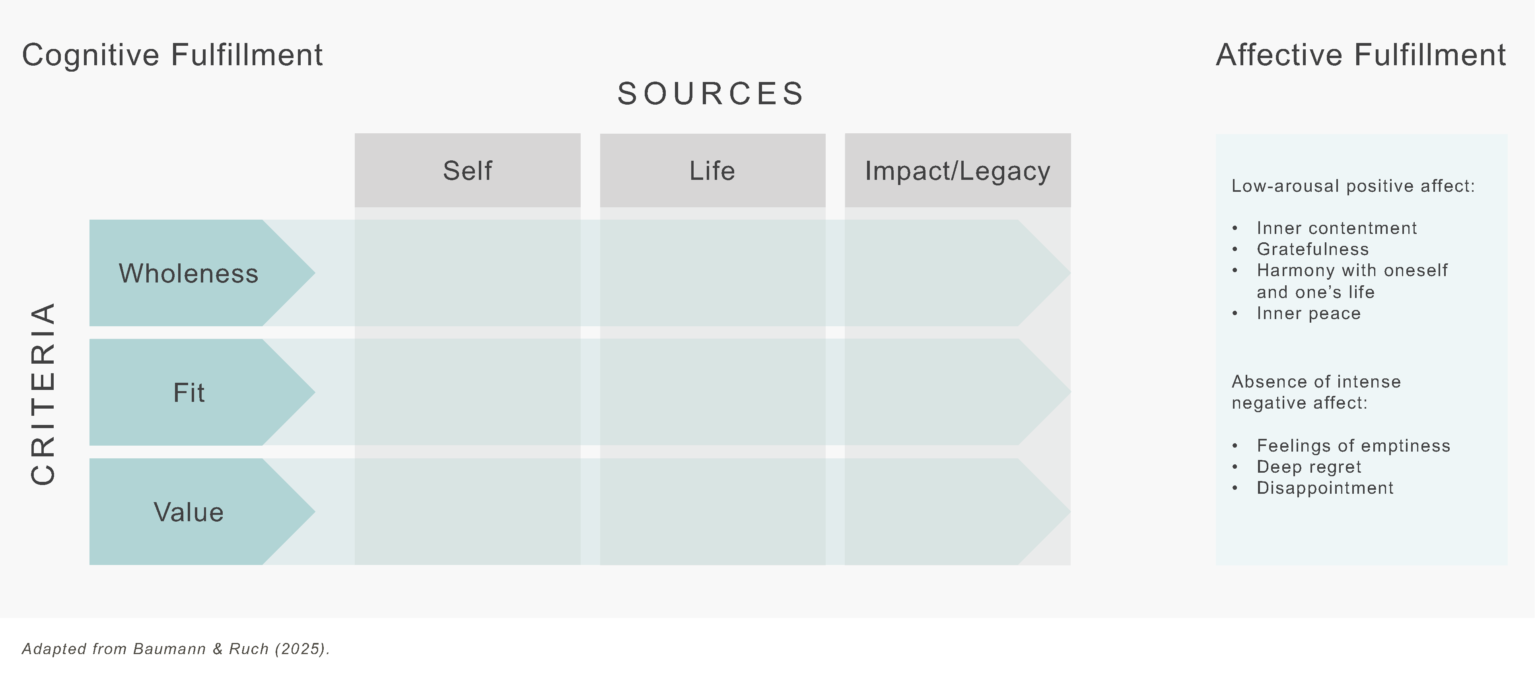
The Fulfillment in Life Model (FiL) provides a theoretically and empirically grounded framework for capturing the essence of fulfillment.
The Fulfillment in Life Model (FiL) integrates insights from philosophical and psychological traditions into a 3 × 3 matrix that systematically describes the essence of fulfillment. The model distinguishes between three sources and three criteria of fulfillment. Their combination results in nine facets of a fulfilled life.
THE THREE SOURCES OF A FULFILLED LIFE
Oneself
The source itself refers to the person. Who you want to be as a person. This includes questions of personal development and the realization of your own potential. What is inherent in me? What should be fulfilled in me as a person?
Life
The source of life focuses on the meaning of life and what should be fulfilled in one's own life. What should my life stand for? Which goals and dreams are worth pursuing?
Impact / Legacy
Fulfillment goes beyond personal interests and also includes contributions that benefit others. Fulfillment also comes from the positive influence we have on others and on society. What do I want to achieve for others? What mark do I want to leave behind?
THE THREE CRITERIA OF A FULFILLED LIFE
Holistic approach / Completeness
Fulfillment means that you have been able to realize your potential to a satisfactory degree. You have lived your life consciously and to the fullest, and you have made a positive difference in the lives of others.
Fit (congruence)
Fulfillment arises when life and self are in harmony. It is about the alignment between what we do and what defines us—our values, strengths, and beliefs. A life that feels coherent and in which we do not become strangers to ourselves.
Value / Significance
That which fulfills us is experienced as valuable and meaningful. People invest time, energy, and talent in something that matters—for themselves and for others. Fulfillment arises when resources are used meaningfully.
These criteria act as filters: Anything that is neither meaningful nor suits us nor conveys a sense of wholeness will not be experienced as fulfilling in the long term.
PERCEIVED FULFILLMENT: THE AFFECTIVE DIMENSION
In addition to cognitive assessment, a fulfilling life also includes an affective component. This is not characterized by euphoric highs, but rather by calm, profound positive feelings such as inner contentment, gratitude, harmony with oneself and life, and inner peace.
Another characteristic of fulfillment is the absence of intense negative feelings such as deep regret, emptiness, or persistent disappointment. Current research on experiences of emptiness illustrates this contrast: those affected describe emptiness as a feeling of meaninglessness, self-alienation, and insignificance—accompanied by the feeling of being unable to contribute.
A LIFE-SPAN-ORIENTED EVALUATION FRAMEWORK
Fulfillment in Life Model understands fulfillment as the result of a lifelong development process. It allows fulfillment to be reflected upon not only at specific points in time, but throughout the entire course of life—in the interplay between self, life, and impact.
The model thus provides a theoretically sound frame of reference for research into successful living, well-being, and healthy aging.